Search BIBLE IN SONG |
| |


Search BIBLE |
|
|

|


| |

Hear the Bible COME ALIVE IN SONG!
Psalm 8King James Version
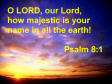
1 O LORD our Lord, how excellent is thy name in all the earth! who hast set thy glory above the heavens.
9 O LORD our Lord, how excellent is thy name in all the earth!1 Bible Commentary 1 The psalmist addresses God, not as a national deity, but as Lord of the universe. Speaking in the name of the people, associating himself with his brethren, he says "our" instead of "my". The individual is forgotten in contemplation of God's majesty in the heavens.2 2 God has used as instruments of His power those who are otherwise as feeble as little children and babies. Through them God has shown His power in causing "the enemy and the avenger" to "still" or "desist" from His plans. Jesus quoted this passage (Matt. 21:16) to vindicate the hosannas of the children in the Temple against the objections of the scribes and Pharisees. Some interpreters see in this verse the key to the whole psalm. In their opinion, the sense is that puny little man is the babe of creation, yet God has given him strength to rule the world of which he is such an insignificant part, and thus conferred upon him dignity and honour far beyond that of the rest of the creation which He governs.2 3 This psalm is the outgrowth of the psalmist's contemplation of the sky at night. The moon and stars shine out. There is no mention of the sun. It is probable that gazing upon the starlit sky at night produces in the heart of man greater awe and wonder than looking up into the sunlit heavens, when the sights and sounds of earth distract from the singleness of contemplation.2
5 In this verse man is described as being made "a little lower than the angels. However the term "than the angels" comes from the Hebrew word "me'elohim" which literally means "than God". The original text translates "Thou hast lessened him for a little time from God. Or, Thou hast made him less than God for a little time". The quotation of this verse in Hebrews 2:7 also reads "angels" instead of God. Whether we read "than the angels" or "than God", man is shown to be on a much higher level than the animal kingdom, because of his kinship with God. Nevertheless, at his best, finite man is far inferior to the infinite God. As king and ruler of the earth, man partakes of the attributes of God, who is king of the universe.2 6 Man is an earthly king, with a territory and subjects. This dominion, given him at creation, has never been entirely lost. Through the victory of Christ man will regain the dominion he had lost.2 7 Flocks and herds are subservient as beasts of burden and farm animals. Animals that roam at large, many of our present-day domestic animals were at one time wild. Their subduing and taming by the power of man is significant evidence that God has placed "all things under his feet".2 9 The statement of verse 1 is repeated. Contemplation of God's majesty and man's dignity as His representative leads to adoration.2 1. King James Authorized Version 1611 2. SDA Bible Commentary Vol. 3 pgs. 648-650 3. Charles H. Spurgeon, "The Treasury of David" - http://bible .crosswalk. com/ Commentaries 4. The Messianic Psalms - www.lwbc .co.uk/ messianic _psalms.htm 5. Scientific Facts In The Bible By Living Water Publications - www. inplainsite .org/html/ scientific _facts_in _the_bible .html |
|
|

 We are not clear upon the meaning of the word Gittith.
Some think it refers to Gath, and may refer to a tune commonly sung there, or an instrument of music there invented, or a song of Obededom the Gittite, in whose house the ark rested, or, better still, a song sung over Goliath of Gath.
Others, tracing the Hebrew to its root, conceive it to mean a song for the winepress, a joyful hymn for the treaders of grapes.
The term Gittith is applied to two other psalms (Pss.
We are not clear upon the meaning of the word Gittith.
Some think it refers to Gath, and may refer to a tune commonly sung there, or an instrument of music there invented, or a song of Obededom the Gittite, in whose house the ark rested, or, better still, a song sung over Goliath of Gath.
Others, tracing the Hebrew to its root, conceive it to mean a song for the winepress, a joyful hymn for the treaders of grapes.
The term Gittith is applied to two other psalms (Pss.